

Key Takeaways
- Advanced waste technologies improve the classification and safe handling of dangerous materials.
- Reprocessing policies for single-use devices reduce landfill contributions and improve cost efficiency.
- Sharps and needlestick injury risks are greatly lowered with proper disposal protocols and staff education.
Increasing medical waste generation demands safer, smarter handling methods to protect both human health and the environment. Modern healthcare facilities, from hospitals to outpatient clinics, must apply effective practices not only for compliance but to safeguard communities. Addressing solutions like advanced waste sorting and sustainable disposal keeps our workplaces and neighborhoods healthier. For facilities in the Southeast, especially Florida, it’s important to understand state-specific best practices. Learn more about safe medical waste management options that protect patients, workers, and the public from preventable hazards.
Beyond collection and disposal, the newest strategies prioritize smarter reprocessing, robust staff education, and up-to-date infrastructure. When innovation meets regulatory rigor, everyone benefits a reality underscored by recent public health emergencies. However, success hinges on smart investments and transparency from providers at every level of the healthcare system. Safe management methods also minimize the risk posed by biohazard waste, ensuring that infectious and hazardous materials remain secure from generation through destruction.
Advanced Technologies in Waste Classification
Effective management begins with knowing what you’re disposing of. Modern healthcare facilities are increasingly adopting AI-driven and hybrid capsule network technologies to classify medical waste. These systems address the historic challenge of misclassification, where recyclable, treatable, and hazardous items often end up in the wrong bin. By using deep learning and visual recognition, waste can now be sorted with greater accuracy, which minimizes accidental exposure to pathogens and toxins. For instance, researchers are actively developing solutions that exceed the capabilities of conventional rule-based models, making waste handling safer and less labor-intensive.
AI and Automation: The Future of Sorting
Facilities using automated waste classification can cut processing times while lowering the risk of overfilling hazardous-waste streams. Improved identification technology also ensures compliance with environmental regulations, reducing the risk of fines and enhancing overall patient safety.
Reprocessing Single-Use Devices
Traditionally, single-use medical devices (SUDs) were intended to be discarded after a single patient use, contributing significantly to landfill waste. Innovative programs now enable the collection, sterilization, and validated reuse of many of these devices. Hospitals adopting SUD reprocessing protocols have reported sustained savings both in budget and waste volume while maintaining strict safety standards. The process is subject to rigorous regulation by the Food and Drug Administration (FDA), ensuring patient safety and performance equivalence of reprocessed items.
Reducing Needlestick Injuries
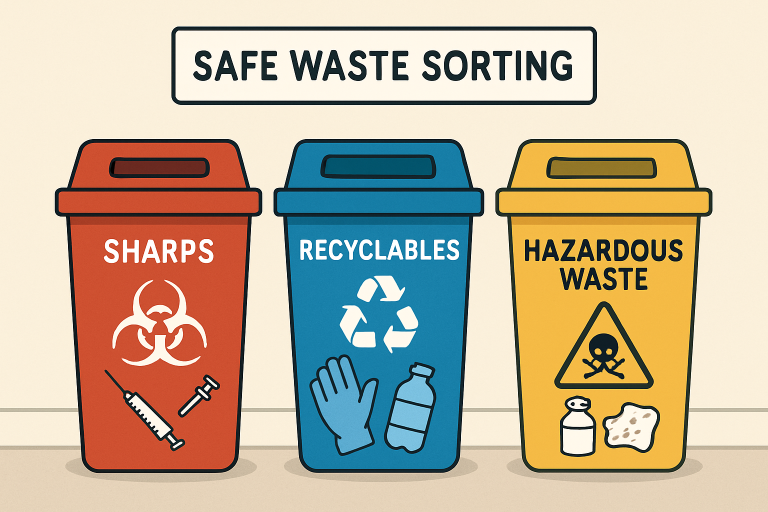
The danger of accidental punctures from used syringes, scalpels, and other sharps remains a leading cause of occupational injury among frontline healthcare workers. In the U.S. alone, the CDC estimates an annual toll of around 385,000 needlestick injuries, which carry not just health consequences, but also economic and psychological burdens for affected staff. The adoption of standardized color-coded containers, accessible disposal stations, and mandatory safety training has started to reverse these trends. Effective prevention policies greatly reduce the transmission risk of bloodborne pathogens like hepatitis B, hepatitis C, and HIV among clinical staff.
Implementing Sustainable Disposal Methods
Ensuring environmentally sound disposal is essential in any modern waste program. Leading facilities turn to high-temperature incineration for hazardous waste and chemical disinfection for certain liquid wastes, balancing hazard elimination with environmental compliance. Some have adopted autoclaving and microwave technologies as alternatives to incineration, particularly for handling less hazardous infectious waste. These strategies, when rooted in the latest science, reduce toxic emissions and environmental liabilities while aligning with national and global sustainability goals. Additional guidance from the World Health Organization emphasizes the need for validated treatment options tailored to facility size and resources.
Enhancing Waste Management Infrastructure
Robust infrastructure is the backbone of any effective medical waste program. Hospitals and clinics that invest in modern autoclaves, waste-tracking systems, and secure storage facilities are better equipped to prevent cross-contamination and accidental environmental releases. The Maldives’ recent health system upgrades, for example, demonstrate how new autoclave installations and tracking protocols can drastically reduce infection risk and bolster community trust. Such investments aren’t just about regulatory compliance; they’re strategic moves for long-term resilience, reputation, and environmental stewardship.
Training and Education
No system is foolproof without the deep involvement of the people who use it. That’s why regular professional development on waste categorization, PPE use, and regulatory compliance is a top priority. Across the Americas, continuous staff education and public workshops have drastically improved outcomes seen in disease transmission and workplace safety. Thoughtful waste management policies, paired with active stakeholder engagement, lead to measurable drops in workplace incidents and pollution from healthcare sources, according to studies by the Centers for Disease Control and Prevention (CDC).
Conclusion
Implementing innovative strategies for safer medical waste management is more than a regulatory necessity; it is a proactive step toward healthier communities, stronger healthcare systems, and a cleaner environment. Through advances in technology, sustainable reprocessing, rigorous training, and infrastructure investment, healthcare providers can effectively reduce health hazards, environmental impact, and operational costs. The future of medical waste management lies in the ongoing integration of new solutions to keep pace with the evolving needs of modern care.
 Arsya
Arsya